Sermon, Lent 5A

John 11:1-45

We find ourselves in an historical moment where everything we say and do is about bodies, and about death. It’s also making us think about big questions, big structural issues, and the shape of the big narrative in which we find ourselves. So this story from the gospel of John has a particular resonance today. It may be uncomfortable, but the scriptures compel us today to talk about life after death.

There are lots of stories about life after death.

There’s the one that goes ‘Somewhere out there is a lovely man called God who is kind and caring. God lives in a wonderful place called heaven and, when people die, they go there to live with him. Grandpa is there, and our cat Flopsy and Auntie Flo and that girl from school who died in the car accident. Pol Pot wasn’t allowed in, neither was Stalin. Nor were any serial killers or wife beaters or people who kick dogs. They all go to a horrible place called hell’

Then there’s the one that goes ‘Everyone is a sinner, even you and me. Sinners go to hell. But if you want to escape hell, you need to believe that Jesus died so that your sins could be forgiven. If you just accept it and really truly believe it, when you die your soul will go floating up to heaven and you can be God for ever. All the Hindus, Muslims and Atheists will go to hell, but hey, they had their chance’

Or this one: ‘God loves everyone and wants everyone to go to heaven. It doesn’t matter what you believe, or how you behave, when you die you’ll go to heaven and God will fix you up. Religious beliefs are nice, though, they help you lead a decent life, give you a sense of wellbeing and the hymns are nice. Everyone goes to heaven, nice people go to church’

Obviously, I’m presenting caricatures – but in my experience beliefs like this are widespread. I suppose this is to be expected amongst those who’ve not been formed in a Christian faith tradition. But, in fact, these narratives about life after death are extremely common even amongst people who are committed participants in a church.

So, what do Christians believe about an afterlife? I’m talking about orthodox, standard, basic Christian teaching, nothing crazy or novel – what do Christians believe about the afterlife?

Firstly, it has to be said the Christian faith does not believe in an afterlife at all – at least not in the sense that it is generally used. Typically, when the phrase ‘afterlife’ is used, it’s used in the sense of the happy hunting grounds, or the Elysian fields – some place where the soul of a dead person (whatever that is) goes to hang around doing who knows what for ever. So no, if that’s what an afterlife is, Christians don’t believe in it.

So this begs the question, what, do Christians believe that when you die that’s it? Your body rots away and all that’s left are memories? Well no, we don’t believe that either – though the way some Christians behave around death you might think we did.

Orthodox Christian teaching is that all people die and that, one day, there will be a general resurrection of the dead when Jesus Christ returns in glory. There will be a reckoning, a calling to account for all people in which our beliefs and actions will be judged. On that day, there will be a new heaven and a new earth, and the reign of Christ will begin – a reign of peace and justice, in which there is no more pain or despair and in which God is at one with the New Creation.

Which brings us to the stench.

In the story of Lazarus which we heard today, Jesus was some distance away. He explains to his disciples that his friend Lazarus is asleep, and that he is going to wake him. The disciples are confused, until Jesus explains that Lazarus is dead. The disciples don’t want to go to Judea, but resign themselves to the idea that they might be killed alongside Jesus. Upon arrival, Jesus meets with Martha. He tells her that he is the Resurrection and the Life, and that those who believe in him even if they die will live, and if they live and believe in him will never die. Martha declares that Jesus is God’s anointed one. Mary arrives and weeps. Jesus weeps as well and asks where they have laid Lazarus. He commands that the stone be rolled away, but Mary protests, because there is a stench.

The parallels with Jesus’ own death and burial are as powerful as they are deliberate. Weeping women, burial in a tomb instead of a pit, lying dead in the tomb for three days, the disciples’ fear of persecution – even the question ‘Where have you laid him?’ prefigures a similar question from the women at Jesus’ tomb. But what of the stench?

When a body dies, various things happen – lividity, rigor mortis, pallor, decomposition. While a dead body can be beautiful and peaceful, without refrigeration the smell quickly becomes unbearable. Lazarus in the story was dead. Really, truly dead. His body was mouldering in the grave.

Jesus did not resuscitate him, Jesus resurrected him. He gained a new body, restored to wholeness, he became a new kind of being.

This act of Jesus is a sign which points to the coming Reign of God, when those who have died are resurrected with a new body and, not only that, the whole of creation is redeemed and restored.

So, of course, we can just sit back and wait for Jesus to return, right? Don’t worry, be happy and hang out for that new body. And try to be nice and believe the right things so that we’re not judged too harshly. Right? Surely that’s logical?

Yet we are the ones who are called out, to stand as witnesses to the resurrection of Christ and his return. God has called us not to simply sit around and silently wait – indeed, how could we when we are privy to that open secret that the Reign of God has been inaugurated and will one day be fulfilled. So how do we live in this in-between time?

Firstly, we pray as if the Reign of God was already here. As if the veil between God and Creation had been completely destroyed and the will of God, my will, and the will of all humanity are one. God is not some far-distant deity to be appeased, but an immediate reality in whom we dwell.

Secondly, we speak as if the Reign of God might arrive tomorrow. I don’t mean in the sense of those fridge magnets ‘Jesus is Coming! And boy, is he mad!’ Rather, when we speak of God and God’s Reign, we speak good news about a future free from fear and hate, in which sin has no more power, and we let others in on the open secret – because its good news for all people, and for the whole universe.

Finally, and this is the hard one, we work as if the Reign of God might never arrive. If we know that one day the hungry will eat and the thirsty will drink, and that the last shall be first, and we wait eagerly for that day – then we can no longer live comfortably in a world at odds with the values of the Reign of God. If we know that one day lies will be exposed and hate will be overcome by love – we can no longer tolerate a world in which hate and lies have dominance. We are fools in this endeavour – because we know we cannot change the world, yet we continue to try.

Things are going to get worse over the next few months. Much worse. Not because we are isolated in our homes – that’s the easy part. The cold reality is that the social structures and systems which have seemed impregnable are already falling apart. The assumptions that have shaped our common life are crumbling before our eyes. And it will be, as always, the poor who suffer most.

So perhaps this is how we live during this time of global pandemic. Praying as if the Reign of God is already here, speaking as if the Reign of God might arrive tomorrow, and working as if the Reign of God might never arrive. This will requires discipline, sacrifice and creativity and it would be impossible if we did not already believe in resurrection – Christ’s and our own.

I am the Resurrection and the Life, says Jesus. Those who believe in me, even though they die, will live, and everyone who lives and believes in me will never die.

The Lord be with you

Sermon, Lent 2A 2020

Sermon, Lent 2A 2020

John 3: 1-17

In Harry Potter and the Goblet of Fire, Professor Dumbledore and Minister of Magic Cornelius Fudge are having an argument about whether Lord Voldemort has truly returned. (If you don’t know what I’m talking about, I can arrange remedial lessons for you). Minister Fudge won’t accept that the baddies are really baddies and Dumbledore accuses of him of placing too much importance on so-called ‘purity of blood’. Finally Dumbledore explodes ‘You fail to recognize that it matters not what someone is born, but what they grow to be!’

Sermon 1 March 2020

Sermon 1 March 2020

Matthew 4:1-11

Every year on the first Sunday of Lent we hear a version of this story, and this year’s version has at least five characters. There’s Jesus, of course, we know him. There’s the Spirit – Pneuma – who compels Jesus into the desert. Then there’s ho diabolo, which our English bible translates as ‘the devil’ and whom Jesus addresses as Satana which our English bible unhelpfully translates as ‘Satan’ as though it is a proper name. Then there’s a couple of angels who appear right at the end to serve Jesus.

Sermon for Ash Wednesday

Sermon for Ash Wednesday

I noticed it first in the classroom as a child, the way we took on assigned roles. I’m sure an expert in group dynamics would have a data set and peer-reviewed analysis. But just based on non-scientific observation as a student and teacher, it seemed that - no matter who ended up in a classroom, and even if half the class was away - there was always a clown, always a goody two shoes, always someone deeply compliant, always a rebel. There was always a couple of kids who were the top of the social tree, and always a couple who were excluded. We took on the roles that were convenient, or were assigned to us, or were forced upon us.

Sermon, Sunday 23 February

Sermon, Sunday 23 February

Let me start with a story, it is a pretend story so don’t worry.

There was this young couple, who tried desperately hard to have children. After years of no success finally the young woman got pregnant and the couple were blessed with a son. They loved their little boy and did everything they could for him. However, as the young boy aged, he didn’t speak. They tried everything to make him talk, cajoling, asking him questions, surprising him. Eventually they were so worried that they took their son to the doctor and specialists who could find nothing wrong with the boy, he just didn’t talk. This greatly affected the couple, who longed to have a conversation with their son. After years, of trying, the boy was 5. The mother, woke up tired and served her son breakfast......it was cold porridge. After one mouthful, the boy said ‘Yuk’. The mother was shocked! She asked her son, why now? Why did you choose to speak? He said, ‘Well up until now, everything was satisfactory’.
This is called, a ‘cold porridge moment’. Have you ever had one of these moments? Where you suddenly felt you had to use your voice? When you reflect on what was and realise that life now has to change? That dissatisfaction has caused you to use your voice?

Sermon, Sunday 9 February 2020

Sermon, Sunday 9 February 2020

This is the second of (only) two sermons on the topic of Giving. Every year around this time – early in the calendar year, but before Lent begins – we take some time to reflect on our financial giving. There is, let’s be honest, a pragmatic element to this. Today after the service, regular parishioners will receive a brochure, and a form to return to the Parish Council with your commitment for the coming year. They’ll trickle in over the next few weeks, then next month the Finance Committee will try to cobble together a feasible budget to be presented to the Parish Council in April, then to the Annual Meeting of Parishioners in June. The purpose of the commitment forms is to declare our intentions for the year ahead, so that the budget can be drawn up with confidence. I usually explain it by inviting people to imagine that you have a job where the boss says they will certainly pay you something, but they won’t say when and they won’t say how much. If all we did was rely on passing around the plate and hoping people would throw in enough to make the place function – well, there would be no functioning. Planned Giving is our mechanism for establishing confidence in our income, and also for enabling all parishioners including me, to make a firm commitment.

Sermon for Epiphany 3A 2020

Sermon for Epiphany 3A 2020

Many years ago some friends prevailed upon me to go and do one of those massed Messiah sing-a-longs, where you have one rehearsal then put on a concert in the Sydney Town Hall. By the end of it I had lost the will to live. I am a fan of Handel, and a fan of the messiah, but I can’t stand Handel’s Messiah. I don’t know why the Hallelujah chorus is so popular and I can’t stand the setting of today’s reading – for unto us a child is tiddly tiddly tiddly tiddly tiddly tiddly tiddly tiddly tiddly tiddly tiddly. What’s with all the tiddling? It really gets on my tiddlies.

Sermon for the Feast of the Baptism of Our Lord

Sermon for the Feast of the Baptism of Our Lord

On 20 December 1940 the first comic book edition of Captain America went on sale. In the first edition, Cap had a shield shaped like, well, a shield. But that made him look too much like The Shield, so in the second edition his shield became round, and has remained so throughout every incarnation of Captain America ever since. The creators of Captain America, Joe Simon and Jack Kirby, were quite clear that their character was consciously political. They supported US involvement in WWII and wanted to advocate for US intervention in the unfolding war in Europe (this was before Pearl Harbour). So the first edition featured Captain America punching Adolf Hitler in the face. A subtle message.

Sermon for Epiphany

Sermon for Epiphany

When I first started singing lessons, one of my party pieces was Imagine by John Lennon. It contains the lines ‘Imagine there’s no countries, it isn’t hard to do, nothing to kill or die for, and no religion too, imagine all the people living life in peace’. It is, in many ways, a beautiful song – though these days I would have some critiques of its assumptions. But the reason I’m mentioning it today is because of today’s useful fact in the sermon series on Isaiah.

Christmas Sermon 2019

Christmas Sermon 2019

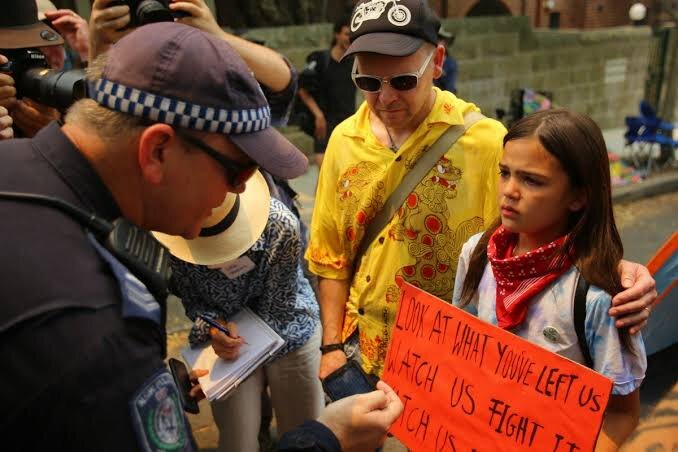
On Thursday afternoon, Izzy and her Dad rode the bus to Kirribilli House. Izzy is 13 years old and, after breathing smoke for days on end, she wanted to demand real action on climate change from our leaders. She and her Dad joined the peaceful protest outside the gates, where obviously the Prime Minister was not in residence because he was in Hawaii. As the day wore on, and after the speeches and chanting, 25 armed riot police showed up in a van and started targeting leaders, arresting them and taking them away. One police officer approached Izzy to demand that she leave. He threatened her with arrest, and told her that ‘force may be used’ if she didn’t comply. The interaction was filmed, and it shows a large, loud police officer standing over this small-framed girl who nevertheless maintained eye contact, and refused to be intimidated. It is a powerful set of images, as this young woman clutches her home made sign, holding back tears but stoically holding her ground.

Sermon, Sunday 22 December 2019

Sermon, Sunday 22 December 2019

Isaiah 7:10-16

As we work our way through pieces of the Book of Isaiah, we are learning useful facts together!

The first useful fact was that the book of Isaiah is in three sections. First Isaiah is from before the exile to Babylon. The bit we read this week is from First Isaiah. Second Isaiah is from during the exile. The bit we read last week, about building a highway in the desert to lead the people home to Jerusalem, is in Second Isaiah. Third Isaiah is from when the People of God return from exile and start to rebuild Jerusalem. One famous part of Third Isaiah is ‘The spirit of the Lord God is upon me, because the Lord has anointed me; he has sent me to bring good news to the oppressed…’

Sermon, Advent 2

Sermon, Advent 2

Isaiah 11:1-10

Before one is ordained as a deacon or priest, one goes to visit a psychologist for a battery of psychometric testing, which includes drawing up a kind of family tree of dysfunction. I was reflecting on that experience this week as I celebrated 16 years of ordained ministry, and I remembered explaining to the friendly shrink that both my grandfathers were alcoholics who abused their wives, probably had post-traumatic stress disorder from their war service and who were both remembered as toxic, aggressive, unkind men with few redeeming features. By contrast, my own Father who this week celebrates 45 years married to Mum, is a gentle and kind man who is beloved by everyone he knows. It is no accident that his two sons are a nurse and a priest (albeit a rather cynical and jaded nurse and priest) and that his grandsons are intelligent, creative, kind and respectful young men. While I’m conscious of the privilege of being white and living in Australia, I’m also conscious that in many families trauma begets trauma from one generation to the next, and I count myself very fortunate that the violence and pain of my forefathers is almost entirely absent from the lives of my nephews.